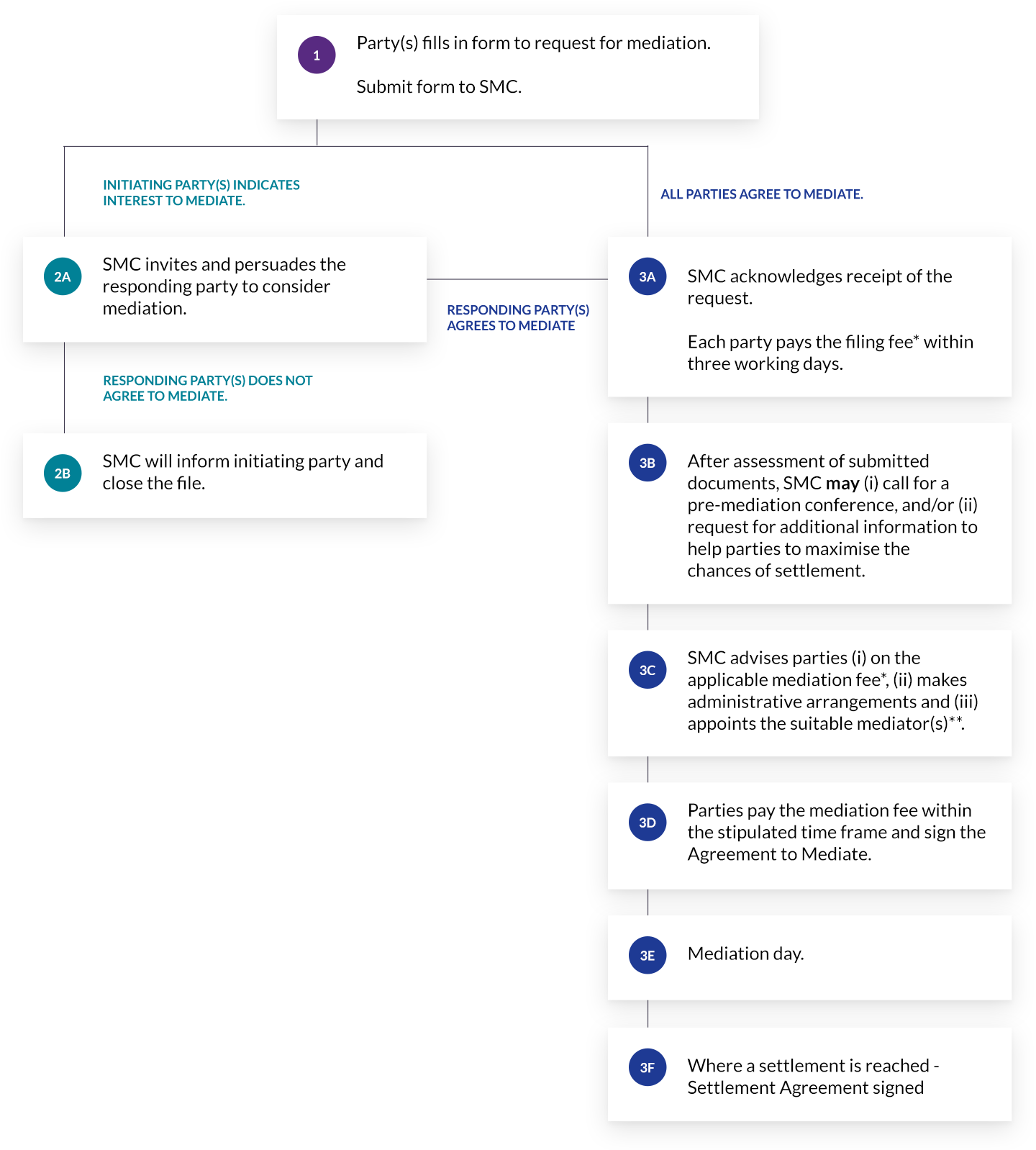
Mediation is a voluntary process involving a neutral third-party known as the mediator who helps disputing parties reach an amicable resolution in private and without going to court. It enjoys a high settlement rate and, in many instances, is a cheaper and faster alternative to litigation.
Unlike the highly-charged and adversarial environment of litigation, mediation is a facilitative process which resolves disputes in a confidential and non-confrontational manner. This enables disputing parties to preserve their relationship post-mediation.
The flexibility of the process also gives disputing parties an opportunity to identify and communicate their differences effectively. Parties are guided by the mediator to focus on issues that are important to them that need to be resolved and consider pragmatic solutions which are mutually acceptable.
Mediation as a dispute resolution process caters to a wide range of disputants, from individuals who face disagreements with family members, to former employees or customers who need to seek recourse for a commercial transaction, to businesses dealing with issues involving their suppliers, partners or customers.
All types of commercial disputes, no matter the size of the claim, can be mediated. The exceptions are:
- Criminal cases
- Cases which require a precedent (e.g. a class action situation)
- Cases where only the courts can give an appropriate remedy (e.g. an injunction or a personal protection order)
- Disputes involving public policies
SMC’s mediation fees are generally pegged to the sum of the claim and counterclaim, whether it is above $60,000 or less than or equal to $60,000.
There are also various subsidised schemes jointly developed with key industry partners for disputes in these sectors: private education, media freelancers, intellectual property, tenancy, healthcare and sports.
SMC also has Family Mediation Procedure Rules to resolve matrimonial disputes with the help of a third-party mediator.